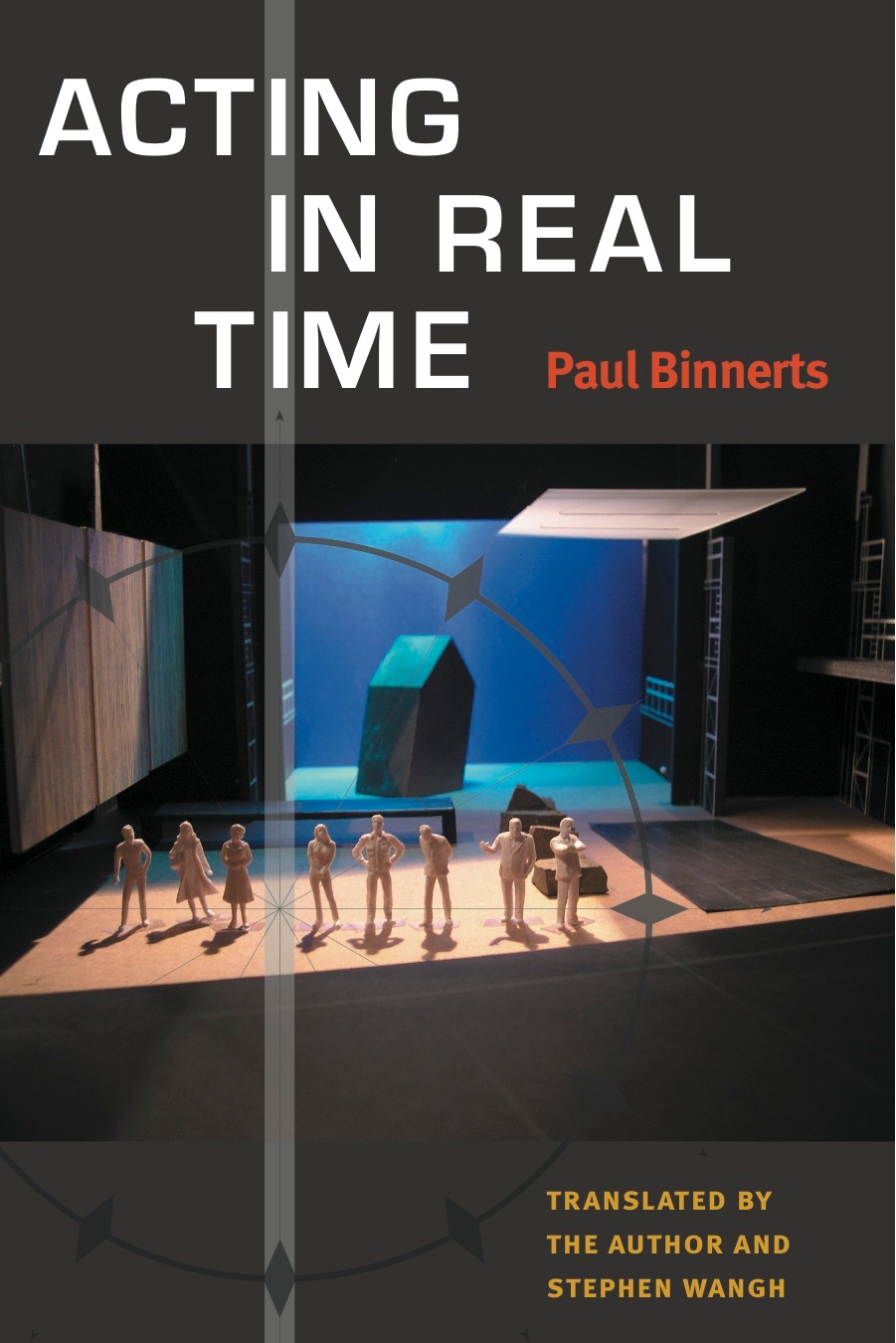
Acting in real time
Acting In Real Time © Paul Binnerts, translated by the author and Stephen Wangh, The University of Michigan Press, Ann Arbor, 2012.
The book describes the method for real-time acting, which authorizes actors to determine how a story is told – they are no longer mere vehicles for delivering the playwright’s message or the director’s interpretations of the text. This level of involvement allows actors to deepen their grasp of the material and amplify their stage presence, resulting in more engaged and nuanced performances. It also allows the audience to participate in the events on stage on an equal level with the actors, without physically taking part in them.
The book describes the essential elements of real-time theater and the real time acting technique. It aims to make this technique (‘method’) available and workable for theater practitioners – actors, directors, drama teachers, dramaturges and stage and light designers, and is even useful for composers, musicians, choreographers, and architects.
Acting in Real Time refers in separate chapters to Stanislavski and Brecht and examines the historical backgrounds of this modern concept of acting, which is defined by a new approach to the notion of ‘time’ in the theater, and new insights in the use of the theatrical space. The book consists of three parts, preceded by an Introduction.
- Introduction. In which the author describes his first encounter with the work of Bertolt Brecht, when he began experimenting with the ‘didactic’ play The Measures Taken. In a two-year long laboratory-workshop with directing students at the Theater School in Amsterdam (1971-1973), and in collaboration with composer Louis Andriessen, they discovered the basic principles of real-time acting.
- Part I, Premises and Inspirations describes, in Chapter 1, The Dilemma’s of the Actor, the manifold identity of the actor, the paradoxes and contradictions he encounters, and what he does when he acts. Chapters 2, The Heart and Soul of the Actor, and 3, The Actor as Eyewitness, put this in the context of the acting conventions initiated by Stanislavski and Brecht - psychological realism and the technique of identification, and epic theater and the technique of alienation - and are analyzed in a comparative manner.
- Part II, Acting in Real Time, is primarily a practical guide, describing the tools the actor needs to act in postmodern theater. In Chapter 4, The Technique, the main skills of real time acting are described, compared with Stanislavski’s psychological realism and Brecht’s epic theater, and illuminated by many examples from the author’s practice. Chapter 5, The Workshop, presents a series of exercises designed to help the actor play a role using the real time acting form. The actors tell a story from their personal lives, take and keep a distance from it, and create first a solo-performance and then a montage of all stories. These exercises can increase the actor’s awareness of his identity as an actor and the natural distance between himself and the roles he plays. At the same time he can gain more precise command of the technique of real time acting. The Exercises, described in Chapter 6, are designed to help the actor become truly present in performance.
- Part III, entitled Real-Time Acting and Theater in Historical Perspective begins in Chapter 7, Origins and Conventions, with the earliest origins of play, ritual, and story-telling, and presents a broad overview of the history of acting, specifically relating the developments in acting to the history of theater architecture and stage design. Chapter 8, New Conventions and Innovations, explores the origins of realism as a theatrical convention. The two major acting conventions of twentieth-century theater - Stanislavski’s psychological realism and Brecht’s epic realism- are also put in this context, eventually leading up to real time acting, where the distinction between play and acting is restored.
Also available in German:
Real Time Acting für ein Theater der Gegenwärtigkeit – Spiel Zeit Raum © Paul Binnerts, aus dem Niederländischen übersetzt von Rainer Kersten,Schibri Verlag, Uckerland/OT Milow, 2014. Lingener Beiträge zur Theaterpädagogik Band XIII
www.amazon.com
www.press.umich.edu
Also available in Dutch:
Toneelspelen in de Tegenwoordige Tijd, tweede geheel herzien uitgave, Amsterdam IT&FB, 2018.